A couple of days ago, I made a trip to Texas. Part of the reason was that I’d previously met a journalism professor at the University of Texas at Austin, and we’d arranged to record a podcast. This year, I’m planning to launch a podcast series exploring algorithms and social media anxiety, and this trip was to gather some material.

On the other hand, my college friend is currently working on a project to transform a cryptocurrency mining facility into an AI computing center, and he said he could take me to see it in person.

This opportunity is definitely not to be missed. After all, Texas might be the only Midwestern state I’ll visit during my year-long research fellowship, offering a chance to see the real America. Meanwhile, the computing power hub is a hot-button topic in the capital markets.

But upon arriving in Austin, I realized the first goal would be tough to achieve. Austin is a city where “a single blue speck stands out among a sea of red”—it bears absolutely no resemblance to the rural heartland of the American Midwest I had imagined. However, I did make some progress toward the second goal, so I want to quickly jot down a few thoughts.
First, let me share my impressions of Austin. If I had to sum them up in three keywords, they would be white, Texas-style barbecue, and chill.

Let’s get straight to the point. This is genuinely the city with the highest proportion of white people I’ve visited so far among the dozen or so cities—big and small—I’ve been to in the U.S. Of course, that doesn’t mean there are no people of color. But having gotten used to seeing people of all skin tones on the streets of New York, California, or Seattle, D.C., my first impression walking around Austin, even at the airport, was, “Wow, this place is really white...” There aren’t even many Chinese people. My traveling companion mentioned that the Chinese population has grown a bit over the past couple of years, but they’re still very rare.

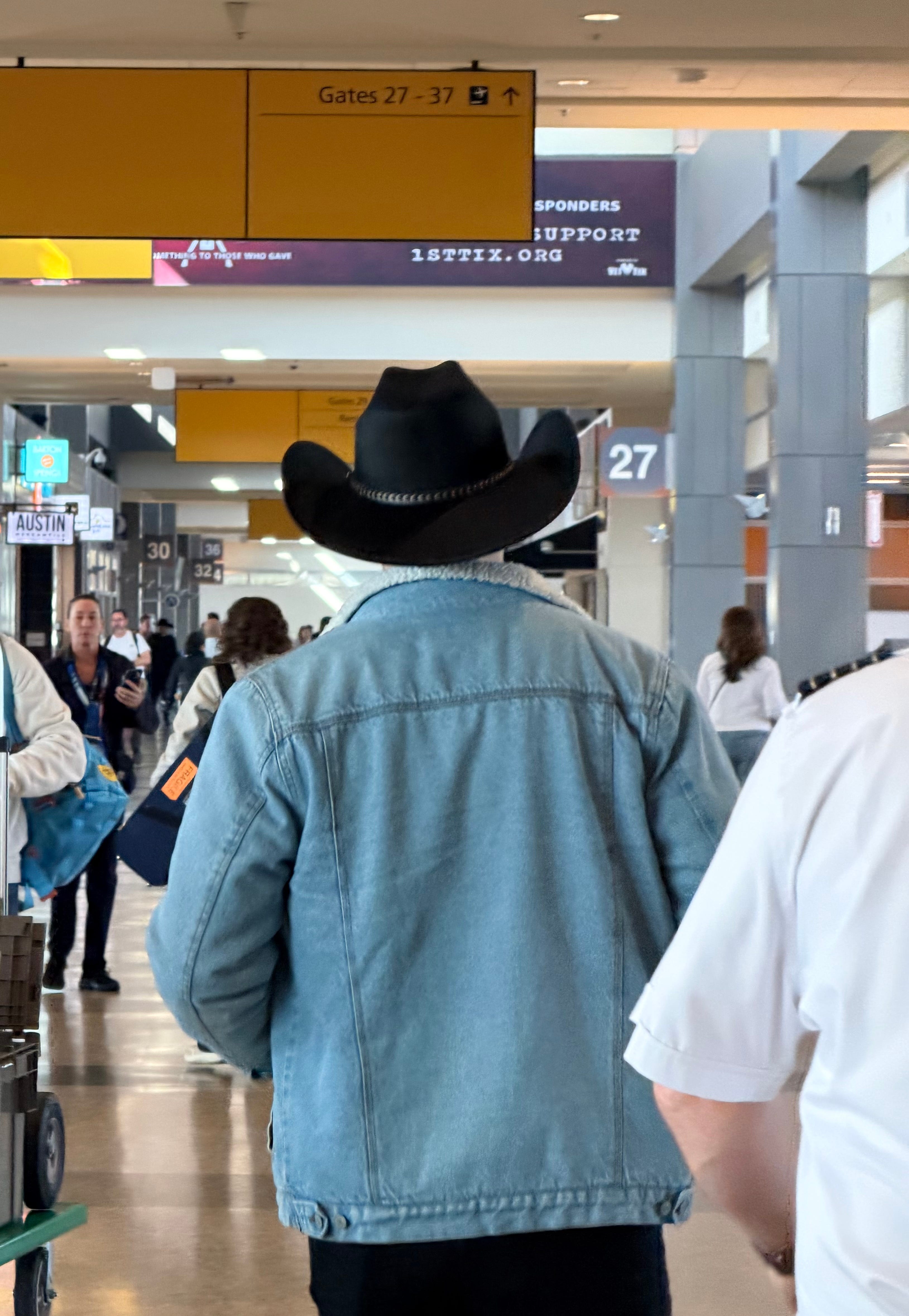
Also, a friend pointed out that there really are way more people wearing cowboy hats and boots here than anywhere else, which might be Austin’s only connection to Texas... Oh wait, there’s also barbecue.
A cowboy hat-wearing guy snapped at Austin Airport

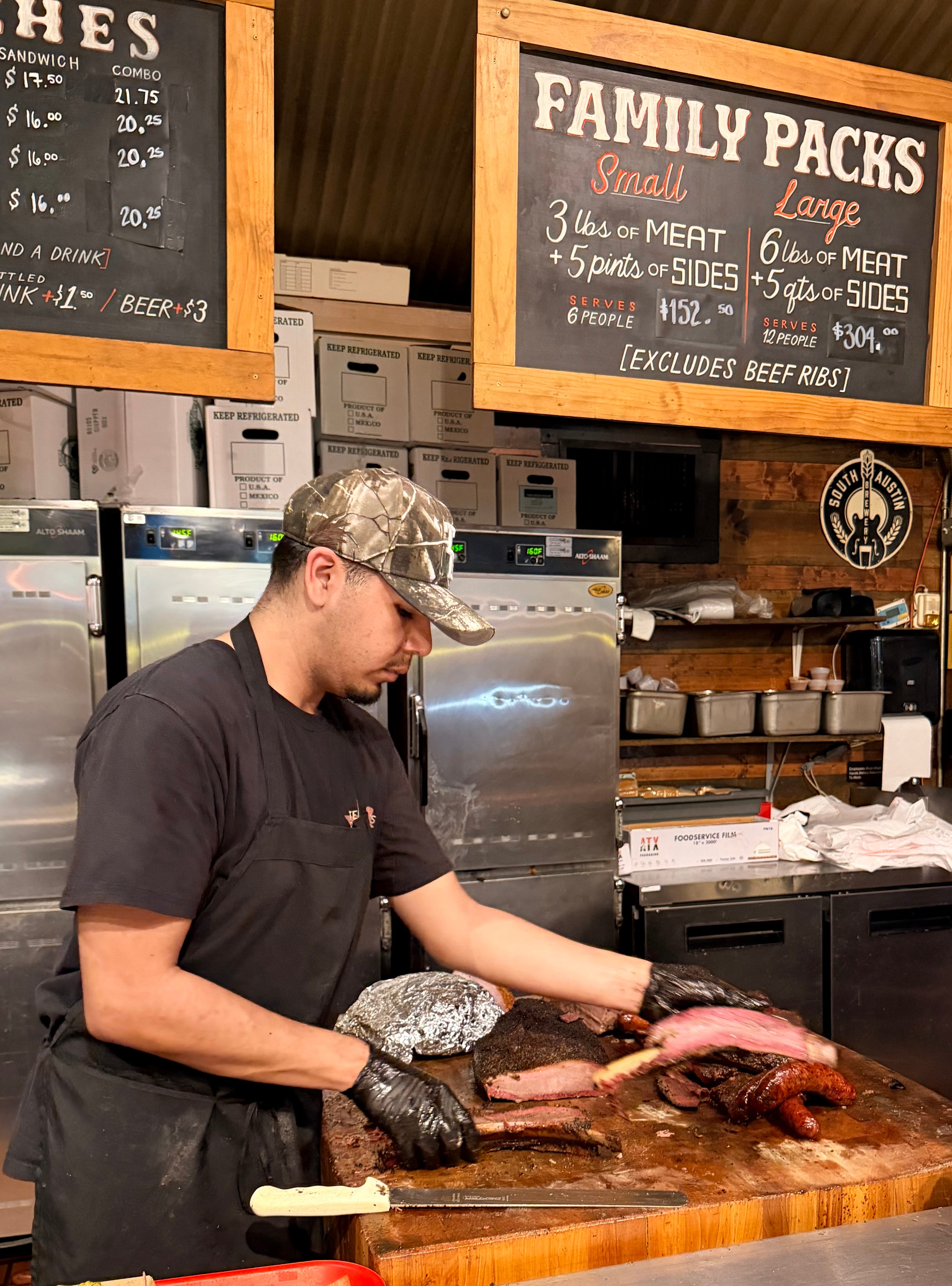
The night before I left, a friend treated me to Texas-style barbecue at a famous restaurant with a line snaking all the way outside. I expected a sit-down place where you browse the menu and order, but instead, you followed the winding queue to grab your own beer and sides, then headed to the checkout area where a burly guy would slice off your chosen cuts of grilled meat—kind of like how we get food at our cafeteria.

I’ve been to similar restaurants in New York before, including one that’s over a century old. These two establishments seem to highlight how, long ago, Americans weren’t nearly as refined as Europeans.

After buying the meat, I plopped down wherever I could find a spot. All around me, Texans were gnawing on big bones—their boldness and raucousness rivaling any Chinese Kaochuan(烤串). Honestly, this might just be the American way of enjoying Kaochuan.
The blackboard behind the guy reads: “Three pounds of meat suitable for six people is $152.”

The grilled meat was actually quite tasty, but after finishing it, we still felt unsatisfied. So we drove half an hour to find a real Chinese-owned Kaochuan spot and had some more.

Hmm, lamb skewers are still the best. My Chinese stomachs are hopeless.

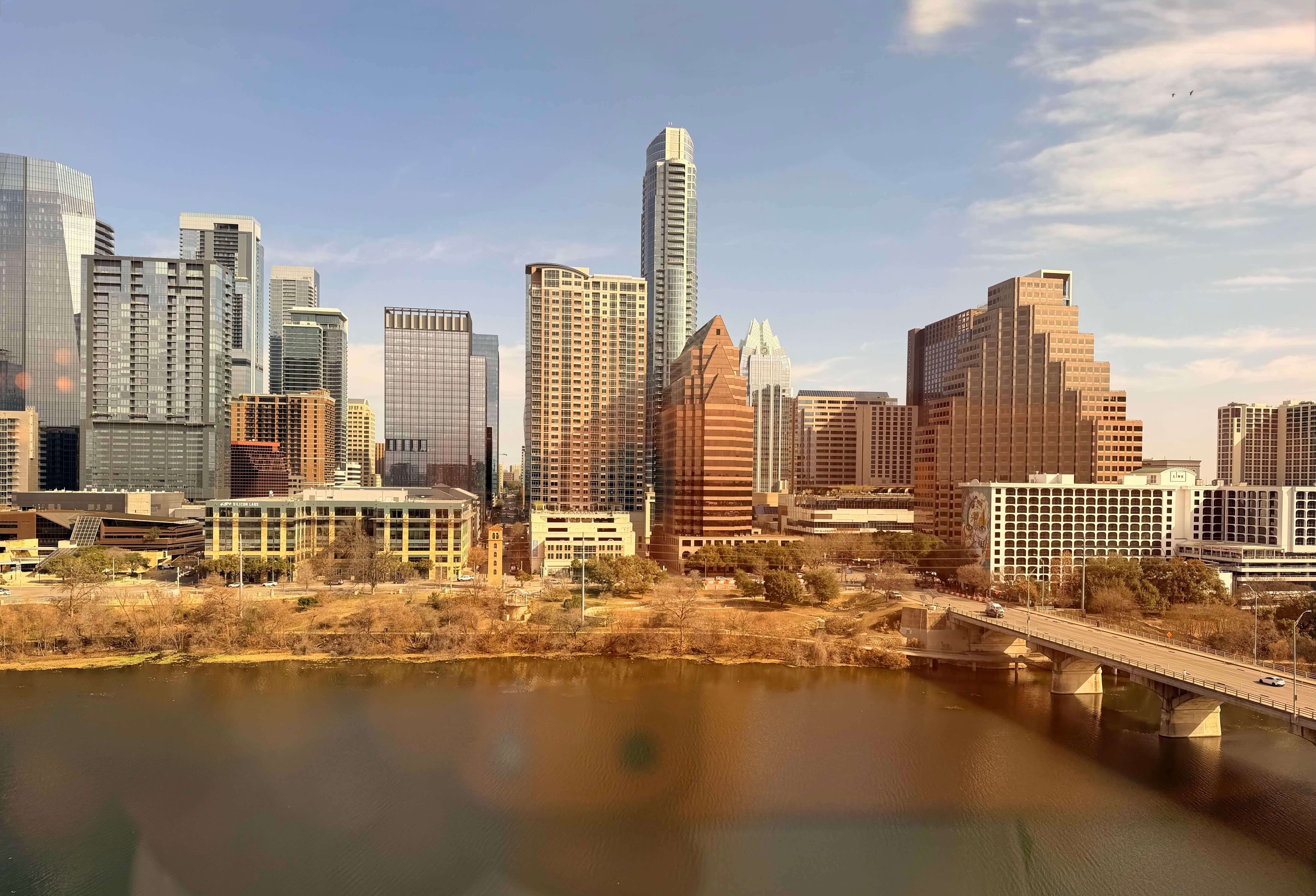
The third feeling is pure chill. Austin’s downtown is well-designed, built along the river. To the south lie conference hotels and trendy commercial districts, plus vast forest parks—the kind where you run five kilometers one way in the morning and still can’t see the end. To the north, skyscrapers rise like a typical CBD.

Austin in winter sees daytime temperatures in the 20s Celsius. On sunny days, both lawns and plazas fill with people, eating, sipping coffee, chatting, all looking like they’ve skipped work...Later I heard that the real economic engines of Texas are Dallas and Houston, while Austin is essentially a college town, which makes perfect sense.
Austin CBD across from the hotel

Austin is the capital of Texas, so I had to visit the State Capitol building.

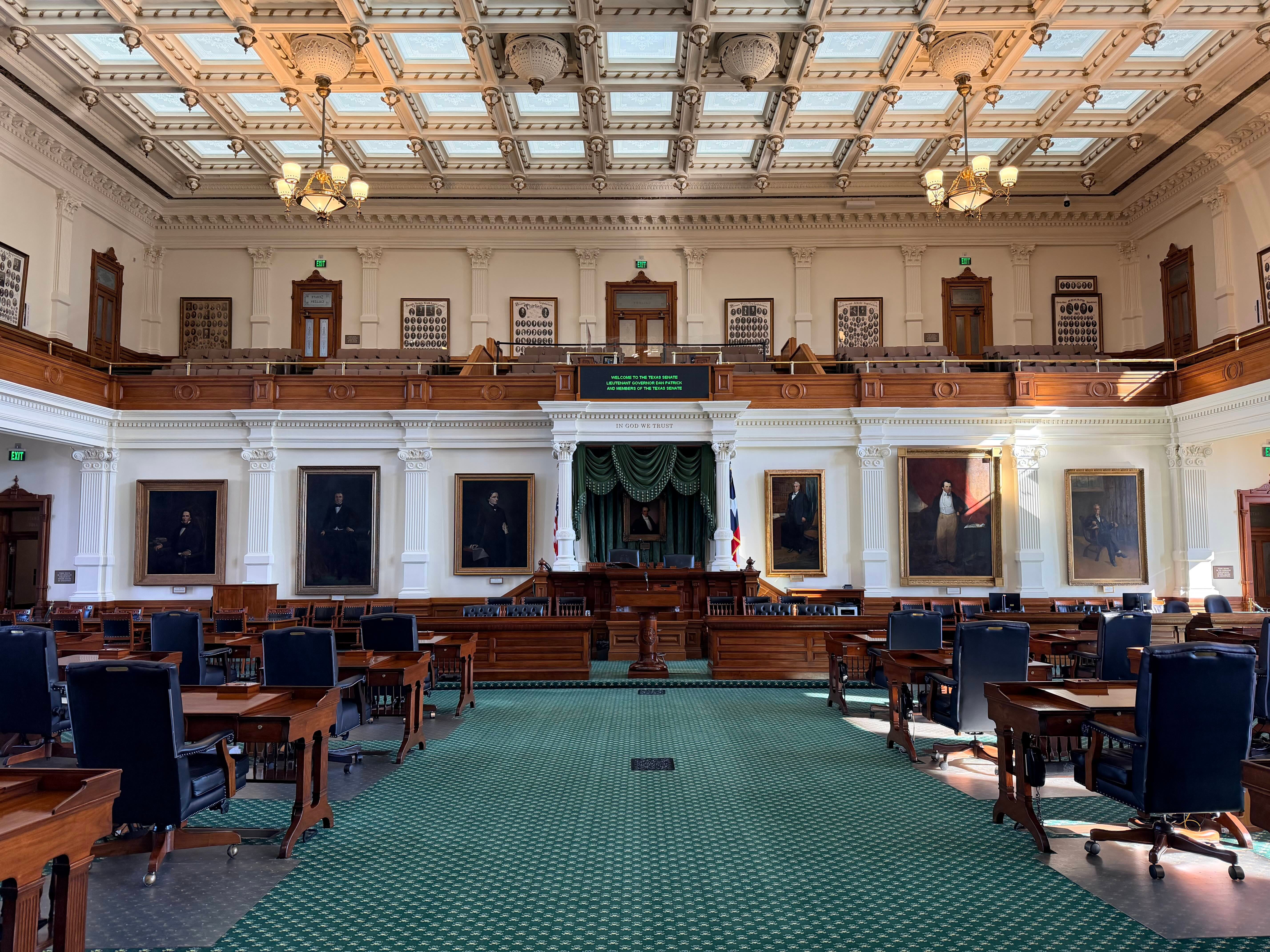
The portrait gallery in the parliamentary chamber has a unique feature: it includes photographs of the members’ children. My friend explained this symbolizes that the work of Parliament is for the next generation. To me, however, it seems more representative of a conservative emphasis on family values.
Senate Chamber

2

The main event of this trip to Austin is undoubtedly visiting the data center, though that’s a vision for the future. For now, it’s still a Bitcoin mining facility.

Over the past two years, a large number of mining farms have begun transitioning into AI Data Centers. While Bitcoin mining has indeed become increasingly difficult, the more significant factor is that the demand side for these data centers is “paying too much.”

For these mining farms, what holds the most value is often not their server rooms or even the land they occupy, but rather the Energy Service Agreements (ESAs) they hold. To put it more plainly, it’s the energized load capacity, the approved power allocation that their mining facilities have already secured and are connected to.

The reason is quite simple: everyone knows the U.S. is currently facing a power shortage. Previously, applying for an ESA with the power company might take a few months or half a year to process, but now the wait time has stretched to three or four years.

The data center, eager to get up and running quickly, began eyeing the acquisition of existing ESA facilities. Among these, the former “power landlord” Bitcoin mining farms became highly sought-after targets. These farms typically held the largest local power permits, and the substations, transformers, and high-voltage lines required for the agreements were already in place—plug-and-play solutions that offered the greatest convenience.

Therefore, once the acquisition is complete, the company behind the data center will demolish and rebuild their facilities within this mining facility, retaining only the substation, and then install new equipment.

What about the idle equipment? In reality, these mining farms simply lease their machine slots to specific cryptocurrency companies, which then haul the equipment away to set up shop elsewhere. It’s hard not to feel a sense of “hearing the laughter of the newcomers, but not seeing the tears of the old.”
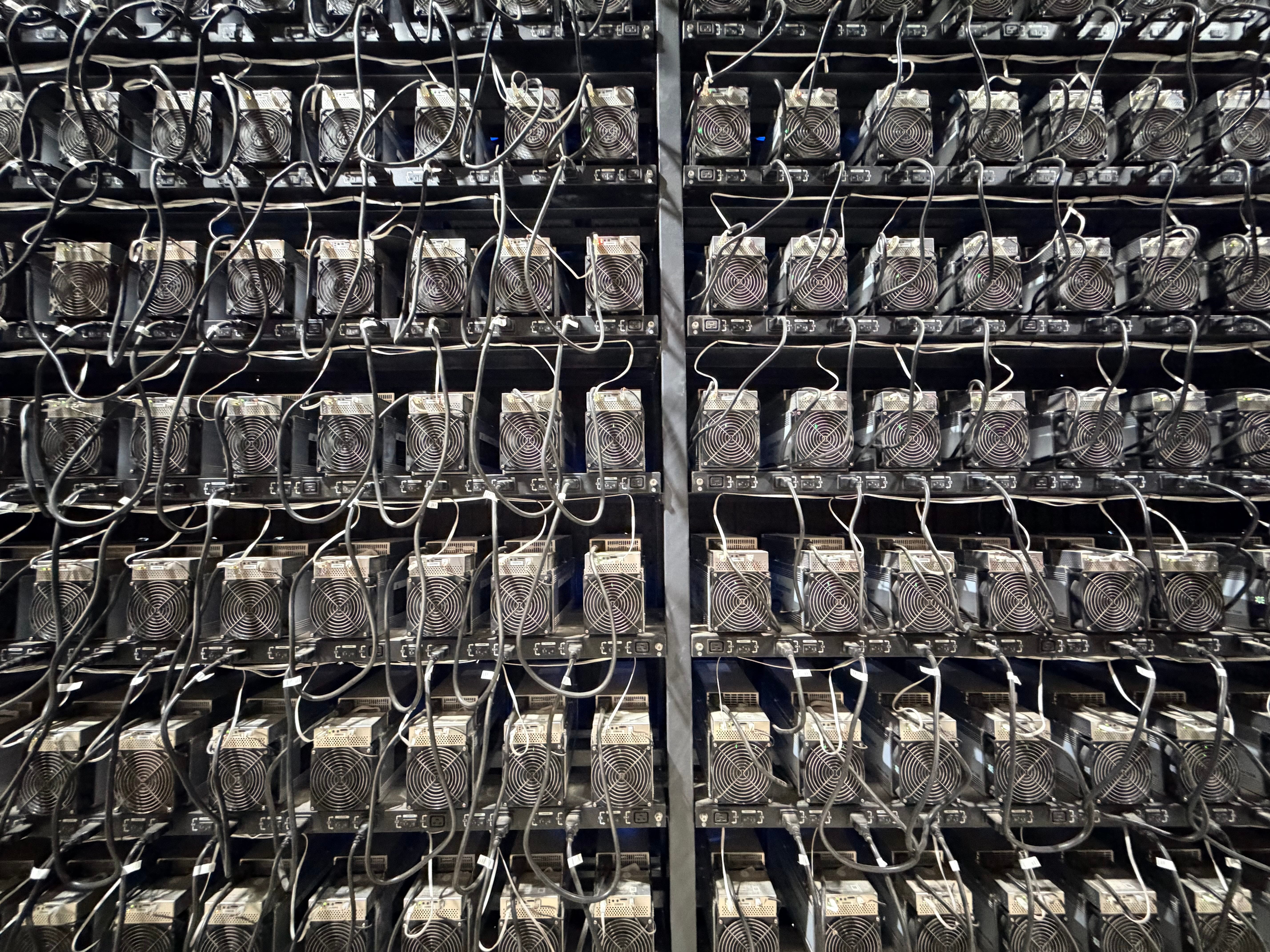
Row upon row of equipments operate around the clock, mining cryptocurrency with the support of air-cooling systems.

During my visit, I had two major takeaways.

First, who says the U.S. doesn’t use clean energy?

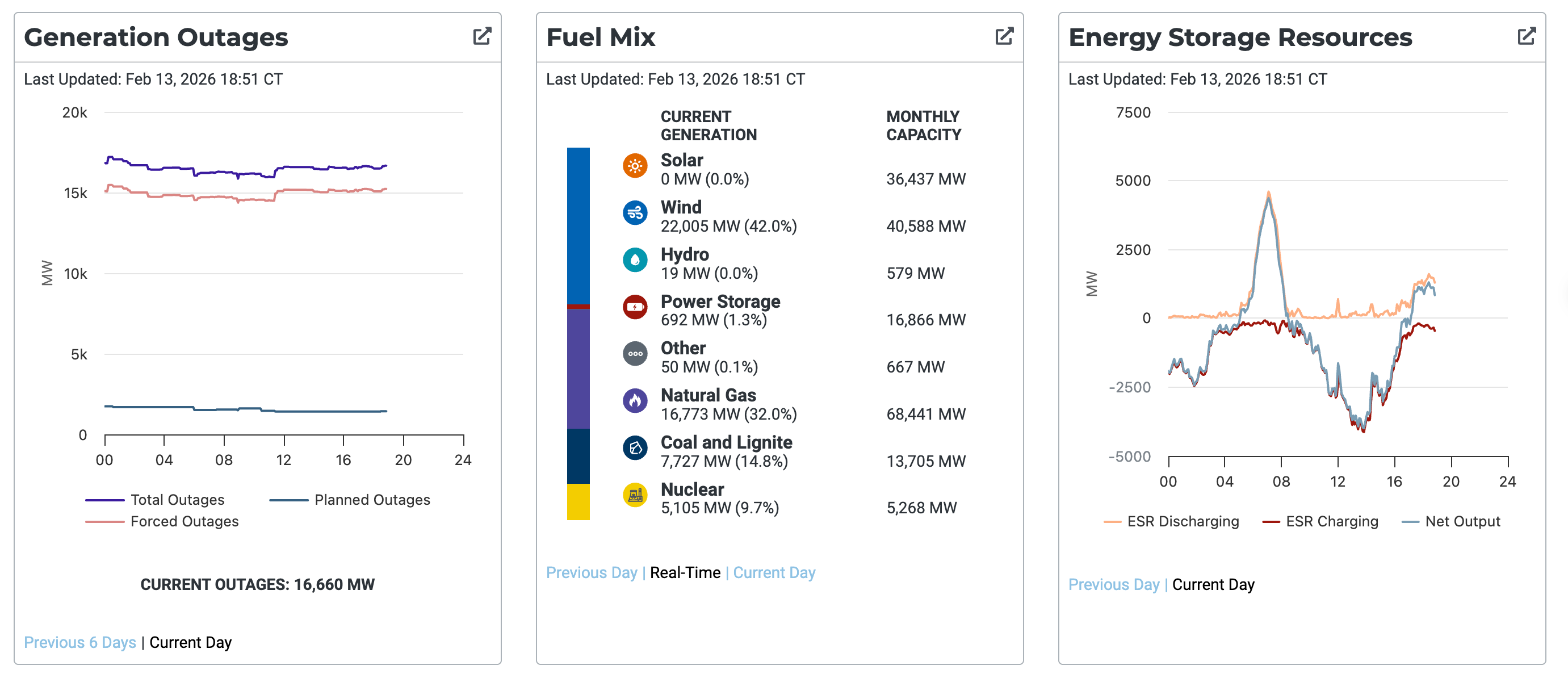
This place displays the Texas Power dashboard on a large screen in the office, showing that wind and solar power account for at least 40% of the electricity supply, sometimes reaching over 70%. The remainder is split between natural gas, nuclear power, and coal, with a small amount of stored energy released at night.

It must be said that while the progress of U.S. power grid construction leaves much to be desired, this dashboard is truly impressive. It’s real-time and open to the public. If you’re interested in Texas power, visit this website to view real-time generation, supply and demand, and even electricity prices:

https://www.ercot.com/gridmktinfo/dashboards
The screenshot was taken at 7:00 PM. The chart in the middle shows that solar power has dropped to zero, but wind power still accounts for 40% of the real-time power generation.

So despite the Trump administration’s constant bashing of clean energy, at least in the two largest U.S. economies, California and Texas, clean energy already accounts for half the pie.

And my friend mentioned that out in West Texas, he could see wind turbines being erected one by one, with solar panels being laid out piece by piece. After all, the terrain and weather there really do resemble Xinjiang...

Another observation is that the world truly can’t do without Chinese manufacturing. Of course, since the mine owner is Chinese, it’s only natural he uses Chinese products. But from the cabinet racks to the power cables, from transformers to small appliances, everything is made in China. In the middle of the desolate Texas wilderness, it’s quite striking.

Of course, the mine manager also mentioned that it’s not that the U.S. can’t buy these materials, it’s that any customization in the U.S. will multiply the price several times over. A standard 20-meter pipe comes at one price. If you only need 15 meters, they can still make it, but the price won’t necessarily be cheaper than the 20-meter version.

In China, due to the imbalance between supply and demand, you can easily find manufacturers supplying products in any size you desire. Even when factoring in tariffs and shipping costs, it remains significantly cheaper than purchasing locally in the United States.

3

Just as the U.S. economy continues to quietly pivot toward clean energy despite whatever Trump says, after visiting Austin, the notion that “computing power ultimately depends on electricity” solidified in my mind.

No matter how dazzling the new models and applications may be each day, in this red-hot sector, capital is still throwing money around to snap up tangible transformers and those energy agreements.

Austin’s white, barbecue’s red, and those Chinese parts shipped across the ocean. Together they form the deepest backdrop of my Texas sourcing trip.

前两天去了一趟德州,一方面是之前碰巧认识了一位德克萨斯大学奥斯汀分校的新闻系教授,约着录一期节目。今年我准备开一个关于算法和社媒焦虑的系列播客节目,这次去进个货。

另一方面是我的大学好友现在正做一个数字货币矿场向AI算力中心转型的项目,说可以带我去现场看看。

这个机会当然不能错过,毕竟德州可能是我这一年访学唯一会去的中部州,可以看看真正的美国,而算力中心是热到烫手的资本市场话题。

不过到了奥斯汀才发现,第一个目的很难达成,奥斯汀是“万丛红中一点蓝”的城市,和想象中的美国中部大农村没有半毛线关系。不过后一个目的倒是有所收获,所以想快速记录一些感想。

1

先说说我对奥斯汀的印象,总结为三个关键词的话,就是白、德州烤肉和Chill。

先说白。这真的是我目前在美国去过大大小小十几个城市里白人占比最高的了。当然不是说没有有色人种,但习惯了在纽约、加州或者西雅图华盛顿这些地方的街头见到各种肤色的人,在奥斯汀街头甚至机场的第一个感觉是,这儿可真白啊……甚至华人都不多。同行的朋友说这两年华人多了一些,但依然非常少见。

另外经朋友提醒才注意到,这里带牛仔帽和穿靴子的人真的比其他地方多很多,这可能是奥斯汀和德州唯一的联系了吧……哦不,还有烤肉。

临走前一晚朋友请我去吃德州烤肉,是个很有名的餐厅,队伍一直排到了外面。我以为是那种坐下来看菜单点菜的餐厅,结果是跟着蜿蜒的队伍自己拿啤酒、小菜,然后到结账的地方让孔武有力的小哥帮你斩下你要的烤肉,有点像我们的食堂打菜。

之前在纽约也去过类似这样的餐厅,还是个百年老店。这两家店似乎彰显着很久很久以前,美国人可没有欧洲人那么文雅。

买好肉之后随意找地方坐下,身边全是抱着大骨头啃的德州人民,豪放和喧嚣程度不亚于中国的烤串店。甚至我觉得,这可能就是美国style的撸串吧。

烤肉其实味道很不错,但吃完之后我们还是觉得不过瘾,驱车半小时找了个真正中国人开的撸串店吃了点。

嗯,还是羊肉串好吃——中国胃真是没救了。

第三个感觉就是Chill。奥斯汀的downtown建设的不错,依河而建,南边是会议酒店和一些trendy的商业区,还有成片的森林公园,早上单程跑了五公里还没看到头的那种。北边则是高楼林立,一副CBD的景象。

冬天的奥斯汀白天有20多度,只要天气晴朗,无论是草坪还是广场都坐满了人,吃饭的喝咖啡的聊天的,都是一副不用上班的样子(bushi

后来听说德州真正的经济引擎在达拉斯和休斯顿,奥斯汀其实是个大学城,那也就合理了。

奥斯汀是德州首府,所以还去议会大楼参观了一下。

挂在议会大厅里的议员图谱有个很特别的地方,是会把议员小孩的照片也放上去,朋友说是象征着议会的工作是为了下一代。不过在我看来,不如说这更代表了重视家庭观念的保守主义。

图片
参议院的议会厅

2

这次去奥斯汀的重头戏当然是去看数据中心——不过那是未来的图景,现在还是一个比特币挖矿的矿场。

这两年大批的矿场开始转型算力中心,一方面当然是比特币越来越难挖,但更重要的是这些算力中心的需求方“给得太多了”。

对于这些矿场来说,很多时候最值钱的不是他们的机房甚至土地,而是他们手握的Energy Service Agreement(ESA),中文叫能源服务协议。或者说的再直白一点,就是他们矿场已经通电且获批的负荷额度(Energized Load)。

原因也很简单,大家都知道现在美国缺电,以前和电力公司申请一个ESA可能几个月或者半年就可以下来,现在排队排到三四年。

于是急着要建成投产的算力中心就动了收购已有ESA的念头,而在这其中,原来的“电老虎”比特币矿场就成了香饽饽。它们手上往往握着当地最大的用电许可,同时协议背后的变电站、变压器和高压线路都已经建成,即插即用,最为省事。

所以等到收购完成后,算力中心背后的管理公司会把这个矿场里那些机房推倒重来,只留变电站,然后放上新的机器。

至于闲置的挖矿机器怎么办?其实这些矿场也都是把自己的机位租给具体的数字货币公司,这些公司把机器拖走放在别的地方便是。不得不说,颇有一种只闻新人笑,不见旧人哭的感觉。

参观中我有两个最大的感受,一个是谁说美国不用清洁能源的?

这个矿场把德州电力的dashboard投在大屏幕上放在办公室里,可以看到风能+太阳能占了至少40%的电力供给,多的时候能有70%+。剩下的被天然气、核能还有煤炭瓜分,晚上还有少量的储能释放。

必须说一句的是,美国电力建设进度不咋样,但这个dashboard做的真不错,实时且向公众开放。大家如果对德州电力感兴趣,到这个网址就可以看到实时的发电量、供需情况甚至电价:

https://www.ercot.com/gridmktinfo/dashboard

所以,别看川普政府天天对清洁能源dis来dis去的,至少美国的经济前两大州——加州和德州,清洁能源都已经顶了半壁江山。

而且朋友说他在西德州还能看到大风车一个一个被竖起来,光伏板一块一块被铺上去,毕竟那边的地貌和天气真的挺像新疆的……

另一个感受就是世界真的离不开中国制造。当然因为这个矿场主是中国人,用中国的东西也很正常,但从机柜架到电源线,从变压器到小电器,全都是made in china,在荒无人烟的德州中央也是非常乍眼。

当然矿场负责人也说了,不是美国买不到,而是美国的所有材料只要涉及到定制,价格就会往上翻几倍。一条20米的标准管道是一个价格,如果你只要15米,对方也能做,但价格未必比20米的便宜。

而在中国,由于供需关系的不平衡,所以你想要什么尺寸都能找到厂家供货,就算加上关税和运输成本,还是会比在美国本地采购便宜很多。

3

就像不管川普嘴上怎么说,美国经济依然在默默倒向清洁能源一样,去完奥斯汀,“算力的尽头是电力”这句话算是在我心中坐实了。

不管每天新的模型、新的应用多么眼花缭乱,但在这个热到烫手的赛道上,资本一掷千金去抢的,依然是实实在在的变压器和那一纸能源协议。

奥斯汀的白、烤肉的红,再加上那些漂洋过海的中国零件,凑成了我这次德州进货最深的底色。


Terry Black?haha